
Woman & Business in Business Insider magazine
Discussing the School’s Woman and Business programme, Mrs MacGinty tells the magazine: “For pupils to hear from women at the very top of their specialist field is, I firmly believe, a rare and invaluable opportunity. It may well change the course of a young life“.
Read the full Business Insider independent schools supplement
Business Insider magazine subscription

Kilgraston’s Maths Department makes national newspaper headlines whilst tackling teen time-telling
Time for action at school where 13-year-olds couldn’t read a clock
- Patrick Sawer, Sunday Telegraph Senior News Reporter
19 January 2020
It has long been a rite of passage for young children; the moment they first begin to grasp how to tell the time as their parents patiently explain the significance of the “big hand” and the “little hand”.
But the ubiquity of mobile phones and tablets, with their digital 24-hour clock, is threatening to make the art of telling the time from a traditional timepiece redundant.
So much so that a school in Scotland has found that pupils as old as 13 are unable to tell the time from the ‘analogue’ clocks hanging in classrooms and corridors.
Teachers at Kilgraston School in Perthshire began to notice that more and more of its senior pupils had no concept of how to read a clock, or at best struggled to do so.
The problem had become so acute that it had even begun to threaten the girls’ exam prospects.
Dorothy MacGinty, head of Kilgraston, said: “Pupils sit in examination rooms with analogue clocks and we have found some who struggle to understand how much longer they have left for an exam because they cannot read the clock face.”
Now the school, in the town of Bridge of Earn, has begun to teach pupils to read a clock the old fashioned way, without resorting to their mobile phones.
In fact mobiles and tablets have been banned during school hours to encourage the girls to look at the clocks around the school.
Teachers began to notice that it was taking longer than normal to teach junior pupils how to tell the time, either because they were not being taught at home or were not receiving “regular reinforcement” from looking at their watches.
However, it quickly became clear the problem was not limited to the younger pupils.
Mrs MacGinty told The Telegraph: “Our head of maths, Mrs Stephanie Speed, mentioned to me that she was also becoming increasingly concerned as more and more senior girls who were joining the school lacked this basic skill.
“Additionally there are maths applications that need this skill. It’s a fundamental numeracy life skill. We are encouraging parents and guardians to buy wristwatches for girls from aged five.”
It’s certainly not a matter of lack of intelligence.
These are pupils, after all, who have happily mastered complex calculus and equations that would stump the majority of adults.
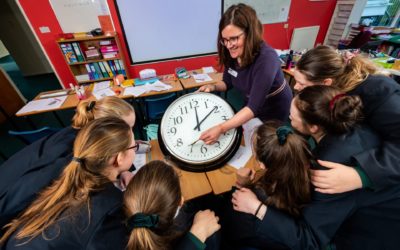
Photo credit: Stuart Nicol/The Telegraph
But just as, following the introduction of domestic electricity, there must have been a generation of children who had no idea how to light the gas lamps their parents had grown up with, the paradigm shift from analogue to digital technology has created a divide in everyday knowledge.
Mrs MacGinty insists however that there are some skills that should transcend the generations.
“Society is changing and the curriculum should change to reflect this,” she said. “But some skills are too important to ignore.
“For example, we are still teaching pupils to read rail and bus timetables, even though it is no longer in the senior school maths syllabus, because it is important that pupils understand how to read these.”
She added: “Having the ability to understand the movement of the minute hand and the hour hand around the face of a clock gives young people a tangible understanding of the passing of time, not just numbers changing on a digital screen.”
Since many of the pupils at the independent day and boarding school, founded in 1930, do not own a wrist watch they were initially reluctant about being separated from their precious mobile phones during the day.
But it appears the rule has had the desired effect of encouraging them to look up at a clock to tell the time.
“Initially I felt anxious about learning to read the time,” said one 13-year-old. “But when I realised that I was not alone learning it didn’t seem to be as scary. Now that I understand it, and we don’t carry phones with us, I find myself using the classroom and corridor clocks to read all the time.”
And as Mrs MacGinty says: “Wouldn’t it be very sad if we got to the point where a whole generation of young people looked at Big Ben in puzzlement?”
ENDS
The story was followed-up by the Daily Mail on Monday 20 January 2020
Don’t be idle at Kilgraston School
“I was approached by Alyth Braithwaite, one of our Junior Years pupils, last term,” said Dorothy MacGinty, Head of Kilgraston, “she was particularly concerned about the effect of air-borne pollution, partially caused by idle engines, on young people and I decided to look into the situation.”
Shocking statistics
Brief investigation threw-up many shocking statistics about an idle engine: The British Heart Foundation’s website states, bluntly, that: ‘Babies and children are especially vulnerable to air pollution as their lungs are still growing and developing.’
Mrs MacGinty said: “Additionally, the Royal College of Physicians estimate 40,000 deaths a year in the UK are linked to air pollution, with engine idling contributing to this figure. Even living in a rural area we are not immune from the effects of pollutants, like PM10 or PM2.5, which penetrate deep into your lung tissue.”
Positive moves
Parent, Claire Alexander, sees the School’s move as very positive: “I think that the idling ban is especially encouraging as it is the children who are recognising and initiating the move. I am wholeheartedly behind the initiative and hope that everyone will join-in with the children’s enthusiasm.”
Kilgraston appreciates that often those offering a ‘taxi’ service to pupils often have to wait while their charges arrive at the chosen point. “We know hanging around for a child can be chilly work,” comments Mrs MacGinty, “so we have written to parents inviting them to come into the school, whatever the time, and wait in the warmth of Reception, rather than sit with their engine running in the car park.”
It’s not just little lungs that suffer
According to respected ‘auto’ website, Spark Plugs’, damage from an idle engine is not just inflicted on human recipients: “Excessive idling can damage your engine’s components, including spark plugs, cylinders and exhaust systems. Because your vehicle’s engine is not operating at its peak temperature when idling, fuel is only partially combusted, leading to a fuel residue build-up on cylinder walls. This is the gunk that can foul your sparkplugs and muck up your exhaust systems,” it says.
All part of the plan
Kilgraston’s no-idling policy dovetails closely with the School’s many environmental initiatives including the avoidance of single-use plastic and the discouragement of ‘fast fashion’, encouraging the use of vintage clothing.

Idling story about Kilgraston School in The Courier newspaper & Schools and Agents website 14 January 2020
Times newspaper features Kilgraston on its front page
A subject that provokes a huge amount of interest among the nation’s parents, The Times’ story was followed-up by the Daily Mail, Herald, Courier, Inverness Press and Journal and BBC Radio Scotland.
“An independent school has recorded its best exam results in five years after it banned mobile phones.
Kilgraston School in Bridge of Earn imposed the ban last year and said it had found an immediate improvement in pupils’ concentration. Kilgraston lifted its phone ban for a Christmas carol concert to help pupils with the lyrics, but it was only staff who were browsing social media because the pupils had “got out of the habit,” Ms MacGinty said. Pupils and parents said that have noticed better communication, a reduction in anxiety and a warmer atmosphere both at home and at school since the ban.”
Read full article in The Times
Head of Kilgraston School, Dorothy MacGinty, also featured in The Independent over the festive break, discussing the need to be discreet and mindful of others while sharing your Christmas presents on social media…
Now in its sixteenth year, the competition is open to all pupils, from Primary One to Sixth Year, across the county of Perth and Kinross and attracts hundreds of entries.
Each year, pupils are asked to submit a piece of artwork depicting a piece of British wildlife in its natural habitat.
The award ceremony was a prestigious event, held in Perth’s beautiful AK Bell Library, presided over by Dr Adam Smith, GWCTs Director of Policy Scotland.
Winning ways
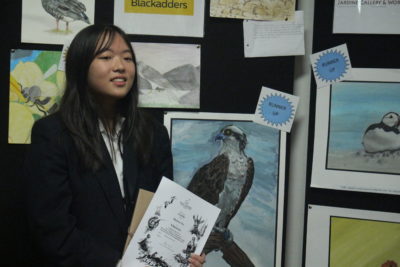
Meteor P, was Runner-Up in the Secondary S1-4 category with her beautiful acrylic painting of a kestrel.
Upper Fifth pupils - India H, with her acrylic of a merlin falcon; Sophia L’s beautiful finch on pastel with acrylic ground; Maia M’s pastel of a puffin and Sana J’s swan and cygnets, all received commended certificates for their entries.
Maia was runner-up in the S5-6 category for her beautiful pastel study of a puffin.
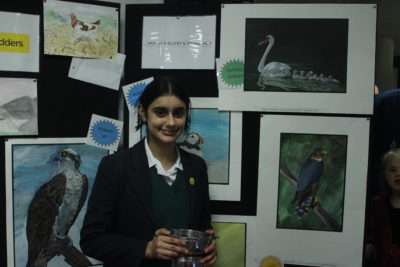
Sana J U5 was the overall winner in the S5–6 category and received the GWCT/Blackadders Solicitors trophy for her stunning painting of a swan and her cygnets. Sana also won a set of six lessons with local ceramicist, Julian Jardine at his studios in Perth, along with a family pass to the Scottish Game Fair.
Kilgraston’s Head of Art, Gillian Macleod, said: “Well done to all the girls, not only the prize winners but also all those who entered the competition. You are all winners in my eyes!”
The artwork is currently on show at the AK Bell Library.

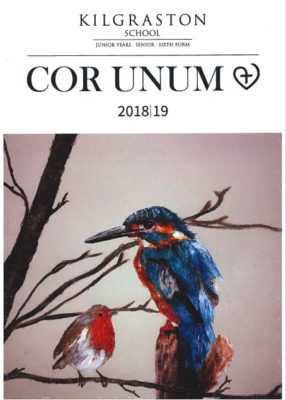
Cor Unum 2018/19 flies off the shelves
“A huge thank you to everyone who has contributed to making the magazine what it is,” said editor and English teacher, Margaret Saunders, “The magazine can never be more nor less than the total, collective input of the school and this year represents a bumper input!”
Front page
The front cover, Kingfisher and Robin acrylic, is by pupil Sara H (Art & Design p30) and, while beautiful in itself, also perfectly encapsulates pupils’ environmental drive and research into dwindling bird numbers (p’s7&18). “Art is an ever-changing response to our experiences and personal viewpoints,” said Head of A&D, Gillian Macleod, “We constantly aim to make courses relevant to individual talents and interests.”
A full curriculum
As ever, Kilgraston’s sports stars (p51) shine; life in the pool, on the running track, over show jumps and across the tennis courts are, among many others, celebrated. “I’ve been passionate about tennis since the age of five,” says Coach Billy McNeil, “I feel very lucky to do this as my job and hope my enthusiasm and passion for the game comes through in my lessons.”
Performing Arts also have their moment in the sun (p34), whisking you away to a variety of platforms: “Creative opportunities allow the girls to develop into learners who are confident and ambitious with high levels of self-esteem,” says Director of Music, Jason McAuley.
In just one year, the quartet of Iceland, India, Italy and Ireland (Northern, but that doesn’t rhyme so well!) on pages 22,40,42,63 each welcomed Kilgraston pupils. “The girls were outstanding and showed great maturity in their participation of a new culture,” said teacher Stephen Johnston, who accompanied pupils on a thrilling two-week trip to a school in the foothills of the Himalayas.
Academic insight and successes – too many to detail – begin on page 15. Of particular note are the super achievements of our Maths Department, with Gemma C detailing her experience at the intensive, invitation-only, Maclaurin National Summer School with pupils from throughout the world.
Junior achievement
The journey starts early at Kilgraston. Junior Years girls highlight their experiences with Lower Third pupil, Niamh S, summing it all up: “This is the first school that I have loved from the very first day. I just want to say, ‘come to Kilgraston!’”
We hope you’ll agree.
Copies can be found at the School’s Reception or online by clicking on the front cover below
Musical medley of Kilgraston talent
Held in the School’s atmospheric Chapel, girls entertained the audience of parents, staff and fellow pupils, with a broad medley of pieces, for over an hour.
St Cecilia is the patroness of musicians and said to have “sang her heart to the Lord” at her own wedding. November the 22 is her feast day and celebrated, musically, throughout the world. Sadly, the lovely St Cecilia is thought to have lost her head to a sword.
On a jollier note, the Fiddle Group got things off to a foot-stomping start, with Marches and MacRostie Park, before Libby B-S’s haunting In French Style on Clarsach put the brakes on the pace and brought goose-bumps to attention.
Next was the light and airy Allegretto Grazioso by Emma D on violin, vibrations swooshing across the auditorium.
Funky US band, Red Hot Chili Peppers, would have been proud to hear their legendary hit Under the Bridge given a twist by the Guitar Ensemble, some of whom had only recently taken up the instrument.
Tricky masterpiece, Nocturne by Tom Hardy, moved among the audience like a stalking serpent as Lourdes O worked her bassoon to the wonderful piano accompaniment of teacher, Gordon Murch.
After this balm to the ears, Emma D, Isabel G H and Emily S – on violin, cello and double bass respectively – whisked us off to the heated dance floors of Rio with the tango tones of Per Una Cabeza.
Not to be outshone by the instruments, Grace C and Amy B belted-out big stage productions of How Could I Know from the Secret Garden and Reflection from Disney classic, Mulan.
Continuing the family favourites, the Clarsach Group transported listeners to the Land of Oz with Somewhere Over The Rainbow.
Demonstrating the breadth and ambition of the show, Lucy I H, on the low-pitch Baritone, hit new heights with everyone’s favourite, Rolf Løvland’s, You Raise Me Up.
The show may have started with its patron losing her head to a sharp implement, but the end cut an even deeper impression. Aram Khachaturian’s legendary ballet, Gayane, finished with the breathtaking Sabre Dance with performers demonstrating their skill with these lethal weapons.
Similarly impressive was Yolanda N’s portrayal of this heart-quickening tune as her fingers danced across the xylophone’s keyboard, bringing the show to its heart-quickening finale.
Phew!
Jump start and finish for Kilgraston riders
The annual event attracts nearly 250 entries with up to 16 teams per class. This year represented Kilgraston’s best results to date, winning three out of the four classes.
Winning ways
Class 1 saw Ishbel F, Meadow B, Lucy H and Hannah A fly round the 55cm with three very speedy double clears to take team 1st, Hannah was also second individually and Lucy fifth place.
Class 2 saw Kilgraston White take the trophy, another three brilliant fast clears from Olivia K, Lucy H and Hannah A. Olivia K took individual second place out of nearly 70 riders! Kilgraston Blue – Maisie F, Meadow B, Grace R and Emma G also took fifth place.
Class 3 and another trophy. This time it was Kilgraston Blue - Mischa S, Flora A, Charlotte J and Emma G riding some outstanding jump off turns to take the top spot of 16 teams, with Kilgraston White - Olivia K, Daisy N and Maisie F taking third place.
Class 4 was the last class of the day, the 1m. Connie W, Erin J, Flora A and Mischa S just had a couple of poles down between them, but still managed team third place.
Rachael MacLean, Equestrian Manager at Kilgraston, said: “It was a brilliant day of sport, with some very competitive classes. The girls all rode so well and got the results they deserved, a huge well done to all who took part and to Strathallan for hosting.”
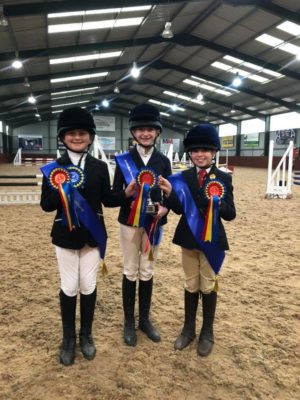
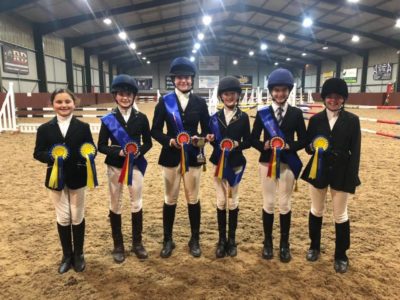

Kilgraston pupils celebrating their success on Sunday 24 November 2019 at the Strathallan School’s showjumping competition at Howe Equestrian
Adding-up to a winner in UK Maths Olympiad
Upper Sixth pupil, Gemma C, will now proceed to the British Mathematical Olympiad Round 1 at the end of November, having scored within the top 60 girls in the country.
Commenting on her achievement, Gemma said: “This gave me the opportunity to apply my existing knowledge to very advanced problems. It was extremely challenging to produce the required full written solutions.”
The Mathematical Olympiad for Girls is a tough, two and a half hour paper, consisting of five challenging problems. Each problem requires a full, written, solution and is marked out of 50. Every year, several hundred pupils take part.
Future potential
Competition organisers use the competition to help identify students who might become members of the UK team for future international competitions.
Gemma’s Maths Teacher, Mrs Vallance, said: “The Maths Olympiad aims to encourage girls to tackle advanced mathematical problems. We only enter pupils who have scored exceptionally well in other UKMT individual maths challenges. I am extremely proud of Gemma’s achievement.”
In 2018, Gemma was a merit certificate winner in the Maclaurin Olympiad - a follow-on round to the Intermediate Mathematical Challenge. This is a two hour competition consisting of six problems requiring full written solutions. Gemma has also attended a week-long UKMT Summer Camp.
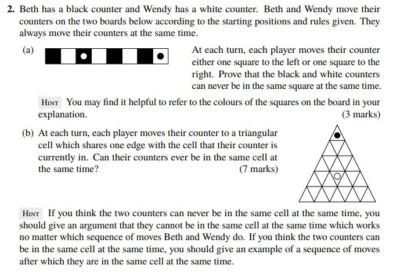
Below is an example question, sat by Gemma, from the October 2019 paper.
© 2019 UK Mathematics Trust
Rewilding your life - grass-roots changes everyone can make
Just some of the fascinating subjects tackled by wildlife presenter and author, Nick Baker, at the Royal Scottish Geographical Society lecture in Perth and enjoyed by several Sixth Form Kilgraston pupils.
During the talk, Nick explained the art of rewilding your life: “It needn’t be a huge change,” he implored, “just something as small as leaving your lawn a bit longer or not clearing flower-beds in the autumn.”
Learning how to observe, connect and discover nature for yourself, Nick asked people to reduce their hemisphere and “swap ear buds for bird song and back-lit LEDs for butterflies,”
His enthusiasm for “opening up your sensorium” struck a chord with the girls: “It really made you think about the world around you,” said Katrina, who’s hoping to pursue Marine Biology at university, “some of the statistics were shocking, (the Tiger Moth population has reduced by 98% since the 1970s and red squirrels were a frequent sight as far south as Dorset just 50 years ago) but it’s important to realise that we can make a difference.”
Kilgraston is passionate about environmental matters, championing the banning of single-use plastic and encouraging ‘fast-fashion’ reduction, as recently featured in Independent School Magazine.
The next lecture, when film-maker Calum Maclean discusses the joys (!) of wild swimming in Scotland, will also be attended by pupils from the school.
