
Kilgraston STEM Challenge event 2023
This week, we welcomed schools from across Perthshire for the inaugural Kilgraston STEM Challenge event - an exciting new competition to encourage our next generation of STEM professionals.
For the past few weeks and months, teams of four or five P5, P6 and P7 pupils from local schools including Kilgraston have been working hard on their projects. The theme was tied into this year’s British Science Week topic of ‘Connections’ and could be interpreted in any way the team saw fit. This saw team entries span topics from robots and rivers, to bridges and brains, with inspirational and wonderful displays and exhibits by each team.
Our teams enjoyed STEM-filled morning with a visit from Tayside Planetarium and a rocket-building session with Kilgraston’s Science Department.
Visiting judge, Dr Mathers, a STEM lecturer at Perth College UHI, spent time with each team who had to present their entry and discuss their exhibit and how it operated. With such high calibre of entry, after much deliberation, the team from Dunbarney Primary School was crowned this year’s Kilgraston STEM Challenge event winners. Well done to Dunbarney and to all of this year’s competitors, it was wonderful to see and meet so many enthusiastic STEM pupils.
Kilgraston is passionate about supporting young people who know their ambitions and are confident to pursue this. Historically, STEM, has been an area dominated by males, however, each year over half of our pupils go on to study STEM subjects at university. We want to continue this legacy in as many ways as we can and we are already looking forward to next year’s event.
Kilgraston alumnae news from Ecuador
We are extremely proud of our Kilgraston alumnae and are delighted to share news from Manon Kempermann.
Manon came to Kilgraston for Sixth Form, leaving in June 2022. She is currently working on projects in Ecuador. Here she shares her amazing experience, there is a link at the bottom on the educational project in the indigenous Kichwa community.
Today marks already half of my time in Ecuador and I almost cannot believe how fast the time is going. The last five months have been incredibly enriching and full of wonderful experiences. I am very grateful to be here and to do this voluntary service. I think, if I had just travelled around, I would not have had the opportunity to gain such deep insights into the culture and the life here.
Apart from being now able to speak Spanish fluently, I have learned so much about myself and how privileged I actually grew up. Until now I supported the English teachers and sometimes taught English alone in two different schools in Tena. Seeing how poorly trained the teachers here often are and how less attention is actually paid at students progress really makes me appreciate what a good education I so far received. Many students especially girls have very low perspectives after school. A number of girls at my age already are married and often have a child. At the same time I feel like I achieved to spark some more interest for English in some kids and with some of the university students I live with I practice English on a regular basis and they are making significant progress. My work in the student house is very diverse and I love the cultural exchange with the indigenous students.
Two weeks ago we started a new project in an indigenous community. We want to send one volunteer to teach English in the primary school of the village. The demand is huge, neither of the two teachers speaks English, but it is still in the curriculum. When the students later go to the senior school in the next city, they have almost no chance to catch up with their class mates, who received at least a little bit of English classes. As no one really cares for them in the school, they often drop out of school early. Now we are building a little hut for the volunteer to live in with the parents of the children. I spent the last two weeks in the indigenous village helping to build the hut. The people are really kind and hard working, but most live in poverty and have almost nothing. I hope we can finish building the house soon and start helping in the school.
Many parents have great hopes that our work can at least improve the perspectives for their children’s future a bit. To realise this project we are currently fundraising on Gofundme. I am very grateful that so many of the Kilgraston family have already supported me at my cake sale last year, but it would be amazing if some of the Kilgraston family wants to support this specific project as well. Thank you already for your support.
Apart from my work in the rainforest, I often use the weekends to travel to the Andes and hike up mountains. So far I have summited three mountains over 5000m over sea level and a couple of over 4000m mountains as well. The landscapes often remind me of Scotland with the green and grassy hillsides and the lagoons in between. I often think back to my time at Kilgraston and what a wonderful year it was. You all really have empowered me and showed me my potential. Looking back, it was definitely my best year of school and you have made me so much more confident as a girl loving STEM subjects. Without all your effort I would not have achieved such results. I know decided to apply for bioinformatics at the University of Saarbrücken.
Here you can find our Gofundme for the educational project in the indigenous Kichwa community:
https://www.gofundme.com/f/haus-fur-volontare (The description in English is below the German)
Many regards to all of the Kilgraston family!
Manon
Sixth Form visit CERN
This September, a small group of Higher and Advanced Higher Physicists lead by Kilgraston’s Head of Physics Mrs Hewett and Head of Modern Languages, Mme Depreux set off at dawn for Edinburgh airport, bound for CERN, near Geneva, Switzerland.
CERN (Conseil Européen pour la Recherche Nucléaire), is where Tim Berners-Lee invented the World Wide Web (originally for sharing data between scientists) and home to the 27km circumference Large Hadron Collider (LHC), the world’s largest and highest-energy particle collider.
Friday was our big day at CERN. After an early start, we set off from the Old Town on Tram 18 to the CERN site on the border with France and Switzerland. After a brief but captivating visit to the Globe of Science and Innovation, we met Professor Makoto Ikeda (who suggested we call him Mac) and over three fascinating hours he took us on a tour of some of the main CERN sites, patiently guiding us through the history and the science of what happens at CERN and questioning the girls to make them think and work out the physics involved.
He talked about the early days of research in the 50s, when the calculations carried out by their first computer were checked by a Dutch maths genius as the scientists were sceptical about the new technology! The huge amount of data generated was (and amazingly still is) stored on magnetic tape.
As a young physicist working at MIT in the US, Mac used to carry these tapes back in his hand luggage! The girls asked lots of questions, some of them quite challenging, and Mac did his best to give each question due consideration. We learned that at CERN the majority of direct employees are engineers and computer scientists, whereas the physicists from universities across the world tend to come to CERN to work on specific projects. After our tour we tucked into a hearty lunch from the CERN cafeteria, sitting out on the terrace in the sunshine with many other scientists.
The girls made the most of the rest of our remaining free time, exploring the beautiful city of Geneva, including travelling on trams and the small boats called moettes and even swimming in the lake. The locals, wrapped in coats and hats, must have thought we were a hardy bunch!
We are already looking forward to returning to CERN.
Kilgraston goes into Space with Tayside Planetarium
Kilgraston went into Space recently courtesy of Matt Williamson, owner and presenter of the Tayside Planetarium.
This epic adventure began with a ‘Journey through Space and time,’ which saw both Lower Third and Upper Third pupils exploring our amazing Solar System. This exploration included the wonders of our beautiful ‘Blue Planet’ Earth, the rocky ‘Red Planet’ of Mars and finally to the gas planet ‘Jupiter’ with its raging storms and hurricanes and a gravity so strong it would crush you!
The pupils of Lower Four took on the ultimate question of ‘is there other life out there?’ In their search for other planets that may have been inhabited they focused on the ‘Goldilocks Zone of the Solar System– where conditions were neither too hot nor too cold!’ A prime candidate considered was a moon of Jupiter called Europa. Europa although an ice-planet is believed to have liquid water in the core beneath its icy crust – an essential for the existence of any life-form. A NASA mission planned for 2030 will send a robot to explore these possibilities.
Finally the Upper Four were educated on advancements in our knowledge and understanding of Space and possible career pathways in Space Engineering. They visited the ‘VLT’ (Very Large Telescope) located in an observatory on Mount Cerro Paranal in Chile at a height of 2,635 metres / 8,645 feet, where atmospheric pressure is lower producing much clearer images of Space.
They learnt about the professionals involved from Astronomers, Physicists, Computer Analysts, Engineers and Educators all working together to collect ground-breaking images and data. From Earth, Upper Four then went into orbit docking at the International Space Station. The Station itself is a giant feat of engineering built from individual modules and taking over a decade to construct. Here they observed experiments carried out by British astronaut Tim Peake.
Women and Business with Professor Kim Dale
“Finding your passion is the key,” Professor Kim Dale told senior pupils at Kilgraston School, “finding that work/life balance is absolutely vital.”
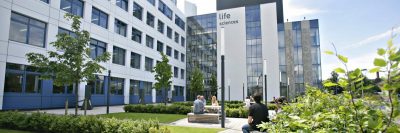
The Professor of Cell and Developmental Biology and Assistant Vice Principal (International) of the University of Dundee, was speaking to girls as part of the School’s Women and Business industry insider lecture series.
A world-expert in Notch Signalling Pathways, the research scientist detailed her own career pathway, starting with a BSc Hons in Cellular and Molecular Biology from the University of Southampton before progressing to a PhD in Developmental Biology and Embryology at London’s UCL: “This was a very tough course,” she told girls, “however, I cannot tell you how exciting it is to be asking a question no-one else in the whole world knows the answer to and you’re going to find!”
This passion for science saw the Professor pursue her interest to sunny southern France and the Campus de Luminy at the CNRS Faculté des Sciences at the Aix Marseille University. Here, she took a post-doctoral position, as an independent scientist, asking “really exciting biological questions.”
Professor Dale investigated embryonic Somite skeletal development and timeframes for different species – in a mouse it’s two hours, in a human eight! For the very first time, the presence of a gene ‘clock’ was established, discovering that if the Notch Pathway was interrupted (the ‘clock’ going wrong) normal development would be hampered.
From here, it was off to mid-west America to a brand-new Science research facility. While here, Prof Dale not only became a mum but developed her own independent research questions and pilot data which allowed her to apply for and secure funding to establish her own research laboratory back in Scotland and to the University of Dundee’s Faculty of Life Sciences.
Upon returning, several new skills had to be learnt - budget responsibility, people management and recruitment. “The biggest key to making it work is employing the right people,” the Professor emphasised, “my success was their success and their success was my success.” Key to success with the cutting-edge research in stem cell development was the team: “We’re all always learning from each other.”
Professor Dale concluded her talk by describing how her career had moved into management, last year accepting the position of Assistant Vice Principal where she draws on her international connections and experience: “Open your eyes for a great mentor at every step,” girls were advised, “always make sure you are passionate about the job.”
Professor Dale was given rapturous applause from all year groups, one pupil commenting: “She was just so inspiring!”
Ewan Connolly, Head of Science at Kilgraston, said: “Being presented with industry experts goes a long way to helping pupils with both tertiary education and career choices. We were very privileged to have someone of Professor Dale’s calibre visit the School.”
Kilgraston School is very proud of the fact that, on average, every year over 60% of Sixth Form leavers pursues an undergraduate STEM subject including, in 2022, to read Natural Sciences at the University of Cambridge.
3.2.22
Kilgraston School’s STEAM success highlighted by international magazine
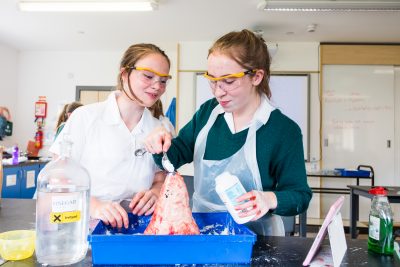
Making sure girls learn to love Physics at school is very close to Kilgraston’s heart: “It’s all about engaging pupils early in their learning journey,” says Head teacher, Dorothy MacGinty, in the autumn term edition of The BSA Guide to UK Boarding Schools.
Featured on the front cover of the international magazine, the article looks at why an all-girls senior school is the ideal environment for tackling a subject more traditionally studied by boys: “Girls feel free to let their natural curiosity reign,” writes MacGinty, “where every question is encouraged.”
Each year, nearly two-thirds of Kilgraston School leavers pursue STEAM (Science, Technology, Engineering, Arts and Maths) subjects at undergraduate level.
“The enthusiasm is definitely there,” states the Head teacher, “but we must continue to deliver the subject in a life-engaging manner.”
Read the full article (front + p124/5) here
6.10.21
STEM at Kilgraston - Mrs MacGinty’s article in Service Parents Guide
STEM at Kilgraston is thriving, exemplified by the numbers of our leavers who go on to study these subjects at university. This year, 2021 is looking to build on this with a quarter of our leavers applying to Engineering degrees.
In the latest version of the Service Parents Guide, Kilgraston’s Headmistress Mrs MacGinty, discusses how we are supporting and engaging our pupils in their learning journey, particularly when learning a subject such as Physics. You can read the entire via the online version of the Service Parents Guide here on page 120.
Kilgraston Science Week 2021
This year for Science Week we are focusing on Space Exploration and on Biodiversity.
We are running a Space Probe Design Competition. The competition will involve students researching and then designing their own space probe complete with model and explanation poster.
It is open to the whole school and will be judged in four age categories, Junior, Fourth Form, Fifth Form and Sixth Form. The competition is inspired by NASA’s Perseverance rover which successfully landed on the surface of Mars on the 18th of February earlier this year.
Its mission is to search for evidence of life in the Martian crater Jezero. A mission which so far has taken many years of work, thousands of engineers and scientists and several billions of dollars to accomplish. However if life is discovered on Mars it would be the scientific discovery of the century, if not the whole of human history, and will confirm that life is not unique to Earth.
Our second activity is the Biodiversity Scavenger Hunt. The aim of this challenge is to encourage students to get outside and engage with the environment around them. Their task is to identify and name as many different plant and animal species as they can. The ability to name the plants and animals around you is a precious skill which can help you to connect with and appreciate the role and importance of each individual species in the environment. Biodiversity is also becoming increasingly relevant as one of the key indicators of climate change and the impact it has on the environment. Understanding the beauty and diversity of the nature around us is a reminder of why it’s so important to preserve and protect our climate for the future.
Winners will be announced in a few weeks so we look forward to sharing this with you then.