
Kilgraston pupils visit CERN
Last week, five students were given the amazing opportunity to travel to Geneva to visit CERN, the largest particle physics lab in the world. We arrived in Geneva late on Thursday night and stayed in a hostel near the city centre until Sunday morning.
On Friday we spent the day exploring the city. It was a beautiful, warm, sunny day – something we all felt we needed! The architecture was stunning, and we were amazed by the Jet d’Eau – the huge fountain in the middle of the lake, which we all got soaked by from running underneath! We also visited a science museum, which was full of fascinating old experiments. In the evening, we enjoyed a delicious meal of a traditional Swiss cheese fondue.
On Saturday we went to CERN: in the morning we had a guided tour of parts of it, including the Control Centre, with all the physics being explained to us along the way. After lunch we went to the visitor centre, which had a lot of interactive games and displays to help us learn and understand the physics behind CERN, from looking inside prototypes of parts of the collider to kicking protons at each other and creating our own stars!
Phoebe, Upper Fifth
Kilgraston STEM Challenge event 2023
This week, we welcomed schools from across Perthshire for the inaugural Kilgraston STEM Challenge event - an exciting new competition to encourage our next generation of STEM professionals.
For the past few weeks and months, teams of four or five P5, P6 and P7 pupils from local schools including Kilgraston have been working hard on their projects. The theme was tied into this year’s British Science Week topic of ‘Connections’ and could be interpreted in any way the team saw fit. This saw team entries span topics from robots and rivers, to bridges and brains, with inspirational and wonderful displays and exhibits by each team.
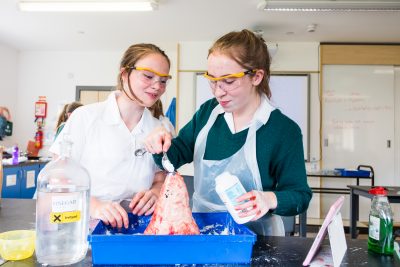
Our teams enjoyed STEM-filled morning with a visit from Tayside Planetarium and a rocket-building session with Kilgraston’s Science Department.
Visiting judge, Dr Mathers, a STEM lecturer at Perth College UHI, spent time with each team who had to present their entry and discuss their exhibit and how it operated. With such high calibre of entry, after much deliberation, the team from Dunbarney Primary School was crowned this year’s Kilgraston STEM Challenge event winners. Well done to Dunbarney and to all of this year’s competitors, it was wonderful to see and meet so many enthusiastic STEM pupils.
Kilgraston is passionate about supporting young people who know their ambitions and are confident to pursue this. Historically, STEM, has been an area dominated by males, however, each year over half of our pupils go on to study STEM subjects at university. We want to continue this legacy in as many ways as we can and we are already looking forward to next year’s event.
Women and Business with Professor Kim Dale
“Finding your passion is the key,” Professor Kim Dale told senior pupils at Kilgraston School, “finding that work/life balance is absolutely vital.”
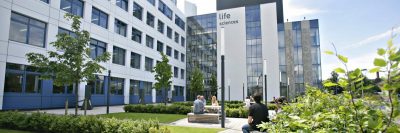
The Professor of Cell and Developmental Biology and Assistant Vice Principal (International) of the University of Dundee, was speaking to girls as part of the School’s Women and Business industry insider lecture series.
A world-expert in Notch Signalling Pathways, the research scientist detailed her own career pathway, starting with a BSc Hons in Cellular and Molecular Biology from the University of Southampton before progressing to a PhD in Developmental Biology and Embryology at London’s UCL: “This was a very tough course,” she told girls, “however, I cannot tell you how exciting it is to be asking a question no-one else in the whole world knows the answer to and you’re going to find!”
This passion for science saw the Professor pursue her interest to sunny southern France and the Campus de Luminy at the CNRS Faculté des Sciences at the Aix Marseille University. Here, she took a post-doctoral position, as an independent scientist, asking “really exciting biological questions.”
Professor Dale investigated embryonic Somite skeletal development and timeframes for different species – in a mouse it’s two hours, in a human eight! For the very first time, the presence of a gene ‘clock’ was established, discovering that if the Notch Pathway was interrupted (the ‘clock’ going wrong) normal development would be hampered.

From here, it was off to mid-west America to a brand-new Science research facility. While here, Prof Dale not only became a mum but developed her own independent research questions and pilot data which allowed her to apply for and secure funding to establish her own research laboratory back in Scotland and to the University of Dundee’s Faculty of Life Sciences.
Upon returning, several new skills had to be learnt - budget responsibility, people management and recruitment. “The biggest key to making it work is employing the right people,” the Professor emphasised, “my success was their success and their success was my success.” Key to success with the cutting-edge research in stem cell development was the team: “We’re all always learning from each other.”
Professor Dale concluded her talk by describing how her career had moved into management, last year accepting the position of Assistant Vice Principal where she draws on her international connections and experience: “Open your eyes for a great mentor at every step,” girls were advised, “always make sure you are passionate about the job.”
Professor Dale was given rapturous applause from all year groups, one pupil commenting: “She was just so inspiring!”
Ewan Connolly, Head of Science at Kilgraston, said: “Being presented with industry experts goes a long way to helping pupils with both tertiary education and career choices. We were very privileged to have someone of Professor Dale’s calibre visit the School.”
Kilgraston School is very proud of the fact that, on average, every year over 60% of Sixth Form leavers pursues an undergraduate STEM subject including, in 2022, to read Natural Sciences at the University of Cambridge.
3.2.22
Kilgraston School’s STEAM success highlighted by international magazine
Making sure girls learn to love Physics at school is very close to Kilgraston’s heart: “It’s all about engaging pupils early in their learning journey,” says Head teacher, Dorothy MacGinty, in the autumn term edition of The BSA Guide to UK Boarding Schools.
Featured on the front cover of the international magazine, the article looks at why an all-girls senior school is the ideal environment for tackling a subject more traditionally studied by boys: “Girls feel free to let their natural curiosity reign,” writes MacGinty, “where every question is encouraged.”
Each year, nearly two-thirds of Kilgraston School leavers pursue STEAM (Science, Technology, Engineering, Arts and Maths) subjects at undergraduate level.
“The enthusiasm is definitely there,” states the Head teacher, “but we must continue to deliver the subject in a life-engaging manner.”
Read the full article (front + p124/5) here
6.10.21
STEM at Kilgraston - Mrs MacGinty’s article in Service Parents Guide
STEM at Kilgraston is thriving, exemplified by the numbers of our leavers who go on to study these subjects at university. This year, 2021 is looking to build on this with a quarter of our leavers applying to Engineering degrees.
In the latest version of the Service Parents Guide, Kilgraston’s Headmistress Mrs MacGinty, discusses how we are supporting and engaging our pupils in their learning journey, particularly when learning a subject such as Physics. You can read the entire via the online version of the Service Parents Guide here on page 120.
Kilgraston Science Week 2021
This year for Science Week we are focusing on Space Exploration and on Biodiversity.
We are running a Space Probe Design Competition. The competition will involve students researching and then designing their own space probe complete with model and explanation poster.
It is open to the whole school and will be judged in four age categories, Junior, Fourth Form, Fifth Form and Sixth Form. The competition is inspired by NASA’s Perseverance rover which successfully landed on the surface of Mars on the 18th of February earlier this year.
Its mission is to search for evidence of life in the Martian crater Jezero. A mission which so far has taken many years of work, thousands of engineers and scientists and several billions of dollars to accomplish. However if life is discovered on Mars it would be the scientific discovery of the century, if not the whole of human history, and will confirm that life is not unique to Earth.
Our second activity is the Biodiversity Scavenger Hunt. The aim of this challenge is to encourage students to get outside and engage with the environment around them. Their task is to identify and name as many different plant and animal species as they can. The ability to name the plants and animals around you is a precious skill which can help you to connect with and appreciate the role and importance of each individual species in the environment. Biodiversity is also becoming increasingly relevant as one of the key indicators of climate change and the impact it has on the environment. Understanding the beauty and diversity of the nature around us is a reminder of why it’s so important to preserve and protect our climate for the future.
Winners will be announced in a few weeks so we look forward to sharing this with you then.
Safe science experiments to try at home!
Always make sure experiments are carried outwith the help of an adult
- Rainbow wizard’s brew
- The will teach your child about chemical reactions between acid and baking soda which react to produce carbon dioxide.
- You will need:
Baking Soda
Water colours or food colouring
Glitter
Dishsoap
Vinegar
Glass jar
Small plastic containers
Tray
Step 1: Fill the jar halfway with vinegar
Step 2: Add a few drops of one colour of watercolour paint or food colouring and some glitter.
Step 3: Squeeze in some dish soap, stir, and place the jar on a tray. Step 4: Add in a heaped teaspoon of baking soda, stir again, and watch the foaming begin!
The soap makes it foam rather than fizz. To keep the reaction going continue adding baking soda and vinegar when the foam starts to slow. To make it change colours, add a tablespoon of vinegar mixed with one color of liquid watercolor/food coloring every so often. Make sure to dump the coloured vinegar into the center of the brew.
Source: babbledabbledo.com/20-science-projects-for-preschoolers/
- Magic an egg in a bottle
- This will teach your child how temperature affects pressure, with the match heating the bottle so it expands and the contracting when heat supply disappears.
- You will need:
Peeled hard-boiled egg (or soft-boiled, if a yolky mess interests you)
Flask or jar with an opening slightly smaller than the diameter of the egg
Paper and match
Don’t forget the adult help
Step 1: Set a piece of paper on fire and drop it into the bottle.
Step 2: Set the egg on top of the bottle (small side pointed downward). When the flame goes out, the egg will get pushed into the bottle.
You can also get the egg out. Please see thought.co.com for more info on this experiment: www.thoughtco.com/egg-in-a-bottle-demonstration-604249
- Grow your own lettuce
- This will teach your child about plant propagation.
- You will need:
Stumpy of any lettuce you have.
Step 1: Place the lettuce hearts in a shallow container of water. Make sure the water does not cover the lettuce.
Step 2: Change the water each day.
Make sure your give your lettuce a daily dose of sunshine and within a week you should have lettuce for lunch!
Source: www.littlebinsforlittlehands.com/growing-lettuce-from-stumps-kitchen-science/
- Make your own lava lamp–
- This will teach your child about density and buoyancy experiment.
- You will need
A clean Transparent PET bottle.
Oil, as an experiment you can try different types of oils and see how this affects you lava lamp.
Water
Alka-Seltzer tablets
Food colouring
Step 1: Fill the bottle about half full of water and add a few drops of food colouring
Step 2: Fill the rest of the bottle with cooking oil,and allow the components to settle and separate
Step 3: Break an Alka-Seltzer tablet into quarters, and drop one piece into the bottle.
Step 4: Watch as the bottle swirls and churns like a real lava lamp!
- Magic milk
- This will teach your child about creating, mixing and testing amongst other things.
- You will need:
Milk – any kind
A bowl or casserole dish
Food Colouring or liquid water colours
Glitter (optional)
Liquid dish soap (don’t use antibacterial or it won’t work well)
Toothpick
Step 1: Pour a small amount of milk in a dish, just a thin film that covers the bottom of the dish.
Step 2: Squeeze a few drops of food colouring or liquid water colours into the milk. Add glitter, if desired.
Step 3: Dip the end of the toothpick into the dish soap and then into the centre of one drop of coloured milk. Don’t stir it, just watch the colour explode.
Source - https://sciencekiddo.com/magic-milk-science-for-kids/