
Green Flag award for Kilgraston
Kilgraston is delighted to have been awarded our first Eco-Schools Scotland Green Flag Award. The Eco-Schools Green Flag is a global award given to young people making a positive environmental impact.
The award judges praised Kilgraston pupils on their commitment and determination, with specific mention to how Kilgraston’s Eco-Code gives a clear message of our mission in how to contribute to the solutions of climate change.
Kilgraston’s stunning countryside campus in rural Perth is already home to red squirrels and a myriad of wildflowers and native trees. Pupils in our Junior School have been monitoring the growth of a hedge, planted in 2009 and now home to many animals and birds.
Our recent COP26 Activities Fortnight also received high praise, as it allowed the students to learn about marine conservation, sustainability and to think about the future.
Kilgraston’s Eco-Committee have been dedicated to achieving the Green Flag Award. Dr Phillips, Kilgraston’s Head of Geography said:
“This has been a long time coming! Our original Action Plan pre-dates the first lockdown, so it is to the credit of the girls in the Eco-Committee that they have been able to maintain their focus on achieving this award, and keep the faith that we could get there in the end. We have to renew this award every two years, though, so this is just the beginning…”
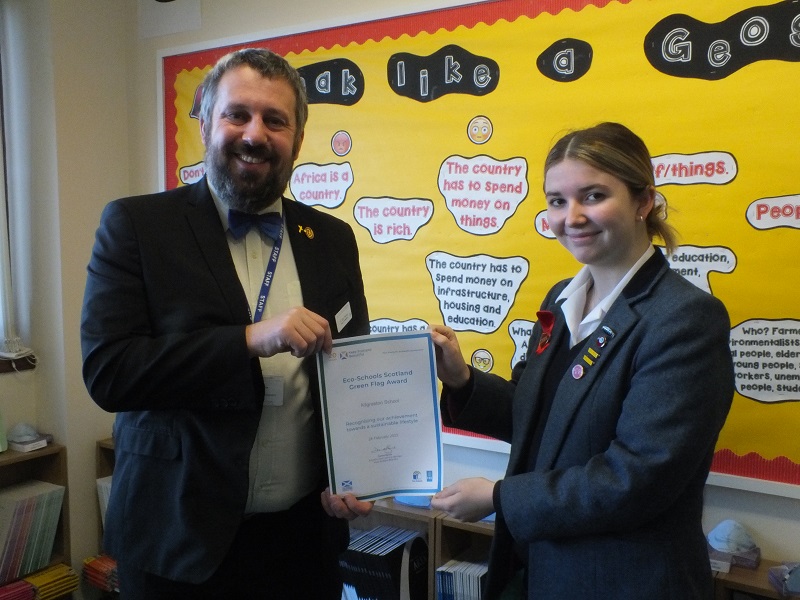
Kilgraston’s Eco-Committee - the Plastic Free School award
Kilgraston’s Eco-Committee delivered an assembly this week on Surfers Against Sewage. Read more below:
Surfers Against Sewage was set up in 1990 by a small group of people who were appalled by the conditions of some of Britain’s coastal waters.
Since then, they have been constantly active, organising beach clean-ups and campaigning for better regulations, and are now turning their attention to the marine plastic problem.
More than 12 million tonnes of plastic ends up in the ocean every year, and Surfers Against Sewage are now campaigning to stop that.
One of Surfers Against Sewage’s newer projects is the Plastic Free Schools Award, towards which Kilgraston is now working.
We have already cut down on the number of single-use plastics used in school, but the Eco-Committee have more in store to help us to become as plastic free as we possibly can.
Please help by cutting down on your use of single-use plastics, and by donating to Surfers Against Sewage at: www.sas.org.uk/donate.
Written by Eco-Committee members Upper Four’s Phoebe and Alexandra
COP26 week two activities
It’s week two of Kilgraston’s COP26 inspired events and as world leaders made a barrage of pledges, staff and pupils signed up to our own Tree of Promises. Headed up by Mrs Saunders, promises to the planet were gathered and displayed on a tree in the glass square. We have all been encouraged to commit our own pledges to pen and paper, adding it to the tree this week and in months or years from now, we will review how we have managed to keep to these promises and the impact it has had. Examples of promises include:
-I will buy less out of season food from different overseas countries.
-Buy clothing from sustainable brands or second hand.
-I will lift share
One of the most difficult-to-replace sources of single-use plastic waste is cling film. So as part of COP26 Activities Fortnight, the Eco-Committee and Dr Phillips held a beeswax wrap workshop to show one way in which you can make your own reusable alternative out of beeswax.
Sacred Heart ambassador, Ann Miller, also caught up with the eco committee via Zoom to discuss their progress and there was also a display of ‘Seaspiracy’ in the Geography rooms.
A special mention to Lower Sixth’s Manon for her outstanding Sixth Form lecture last week related to cop26 and our need to look at food for the future.
Find out more about last week’s events here.
Kilgraston COP26 activities
During the two weeks of COP26, the senior school Eco-Committee is running a series of activities that are intended to be fun, and to encourage as many as people to take part, but that are also intended to be educational and to make people think. These activities have ranged from a scavenger-hunt style quiz around the school buildings, collecting food waste at lunchtime, and launching a ‘Future Visions’ art and writing competition, with more to come next week.
Ruby Forbes, the Eco Prefect, said: “As part of the Eco-Committee, I was keen for us to take the opportunity of COP26 being held in a Scottish city to start activities all throughout the school, to try and help our school community gain greater awareness of our climate crisis and what steps we have the power to take to try and solve it. The activities have been really successful so far, and we’re really looking forward to what we’ve got planned for next week.”
Look out for more COP26 eco-events next week including representatives from Kilgraston attending the COP26 mass. In the meantime, read this article more information on other eco committee activities.
Eco Committee launches Kilgraston Tattie Champion competition
The senior Eco Committee has been working towards the Keep Scotland Beautiful ‘Eco-Schools’ green flag award.
One of the targets for this year was to grow some of our own food in school. However, lockdown has meant that this was unable to happen, so as an alternative, the Eco-Committee invited all Kilgraston staff and pupils to take part in a home potato growing competition.
The winner will be defined by the person who can grow the biggest total weight of potatoes.
We look forward to finding out who will be crowned Kilgraston ‘Tattie Champ’ 2021 later this year.
Kilgraston’s commitment to the environment
Kilgraston’s Junior School has been busy charting the growth of a hedge planted in 2009, part of Kilgraston’s on-going commitment to the environment and educating our pupils on nature.
Speaking in the Catholic Universe, Ms Dana Cooper, Junior Years’ teacher and head of the school’s Eco Committee said, “We thought it would be demonstrated particularly well if we showed our eleven-year-olds what nature can do in the same period. Our pupils are particularly interested in natural habitats for indigenous wildlife, which we have an abundance of here at school, but they are also keen to create artificial habitats and, additionally, are currently building a ‘bug hotel’ out of palettes and recycled materials.”
The hedge, which is made up of hawthorn, common lime, hazel and the guelder rose, stretches along the Kilgraston beautiful countryside campus next to the school’s swimming pool. Now, eleven years since it was planted, the hedge reaches four and a half metres high in places and is almost 80 metres long.
Upper Third’s Edith, who is Head of the Junior Years Eco Committee, said: “We have been learning how the hedge provides wildlife with a natural larder.
“Birds such as thrushes, blackbirds and fieldfares love the rose hips, while bees enjoy nectar from the hawthorn and robins, red squirrels and rabbits enjoy the berries.”
This story also featured in the November issue of magazine, Scottish Field.