
Kilgraston goes into Space with Tayside Planetarium
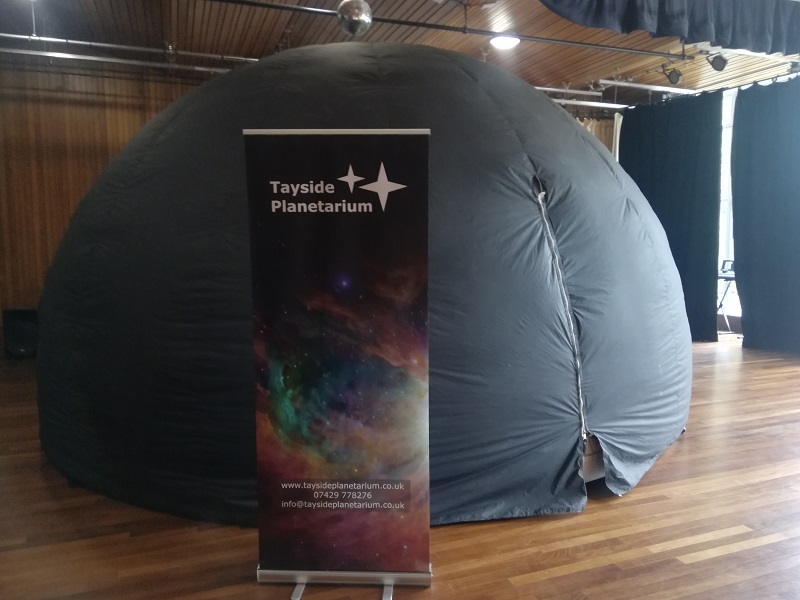
Kilgraston went into Space recently courtesy of Matt Williamson, owner and presenter of the Tayside Planetarium.
This epic adventure began with a ‘Journey through Space and time,’ which saw both Lower Third and Upper Third pupils exploring our amazing Solar System. This exploration included the wonders of our beautiful ‘Blue Planet’ Earth, the rocky ‘Red Planet’ of Mars and finally to the gas planet ‘Jupiter’ with its raging storms and hurricanes and a gravity so strong it would crush you!
The pupils of Lower Four took on the ultimate question of ‘is there other life out there?’ In their search for other planets that may have been inhabited they focused on the ‘Goldilocks Zone of the Solar System– where conditions were neither too hot nor too cold!’ A prime candidate considered was a moon of Jupiter called Europa. Europa although an ice-planet is believed to have liquid water in the core beneath its icy crust – an essential for the existence of any life-form. A NASA mission planned for 2030 will send a robot to explore these possibilities.
Finally the Upper Four were educated on advancements in our knowledge and understanding of Space and possible career pathways in Space Engineering. They visited the ‘VLT’ (Very Large Telescope) located in an observatory on Mount Cerro Paranal in Chile at a height of 2,635 metres / 8,645 feet, where atmospheric pressure is lower producing much clearer images of Space.
They learnt about the professionals involved from Astronomers, Physicists, Computer Analysts, Engineers and Educators all working together to collect ground-breaking images and data. From Earth, Upper Four then went into orbit docking at the International Space Station. The Station itself is a giant feat of engineering built from individual modules and taking over a decade to construct. Here they observed experiments carried out by British astronaut Tim Peake.
Back to News

