
Diamonds in the Arctic
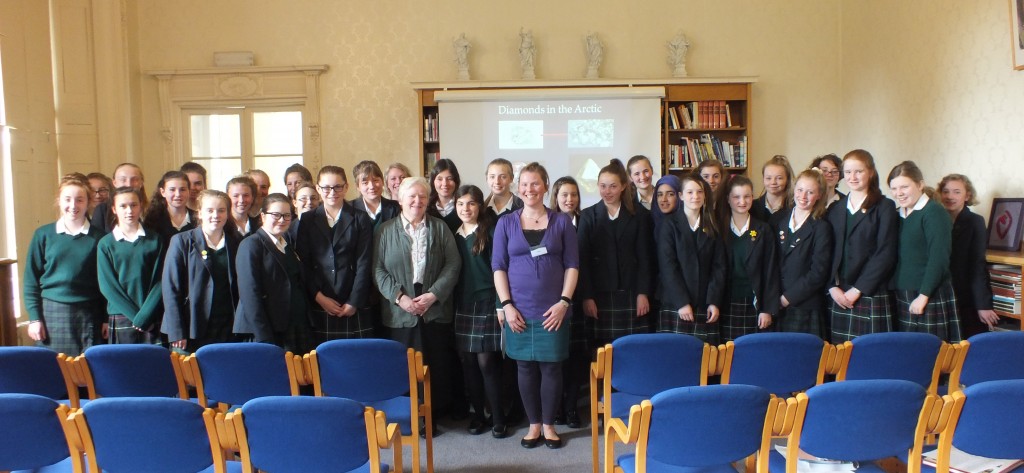
Girls at Kilgraston have been inspired to become geologists after a talk by a Canadian academic who is currently hunting for diamonds in the Arctic!
Dr Sarah Woodland came to talk to the Upper Fourth at the invitation of Kilgraston Lab Technician Miss Blackler with whom she studied at CardiffUniversity.
Dr Woodland is a geochemist working in the Arctic Resources Laboratory at the University of Alberta in Canada.
In her wide-ranging talk, entitled “Searching for Diamonds in the Arctic”, Dr Woodland explained how the state-of-the-art instrumentation can date and trace a wide spectrum of Earth materials - from diamonds and gold to meteorites, volcanic rocks and ash-falls.
She said: “The techniques we have developed have led to extensive collaborations with pharmacologists interested in studying new generations of drugs that are very effective against certain types of cancer.”
Dr Woodland inspired the girls with her tales of the challenges and rewards of a career in geology – such as collecting meteorites in Oman and studying fossils in the Caribbean.
The girls were particularly fascinated by her stories about Otzi the Iceman, Europe’s oldest human mummy. Found in 1991 in the Alps, the well-preserved mummy has provided unprecedented insights into people who lived in Europe over five thousand years ago.
Dr Woodland explained how Otzi has been extensively examined, measured, DNA-tested, X-rayed and dated, even drilling his teeth to study the enamel which showed what foods he ate – showing geology working closely with archaeology to reveal vital data.
Principal Mrs Lund said: “I am sure Dr Woodland will have inspired some of our girls to consider a career in geochemistry.
“STEM – the study in schools of science, technology, engineering and maths – is at the heart of our curriculum here at Kilgraston. It brings hands-on, inquiry-based real life experiences to our girls in the classroom.
“Our girls are offered science subjects from an early age and we have found that specialising in this area in the early years gives them confidence and an excellent set of skills as they mature. It encourages them to go on to related degrees and pursue science and engineering careers, areas where woman are greatly under-represented.”
Back to News

