
Biodiversity bonanza
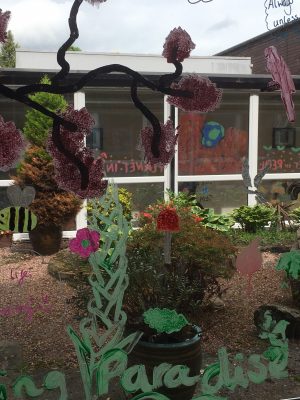
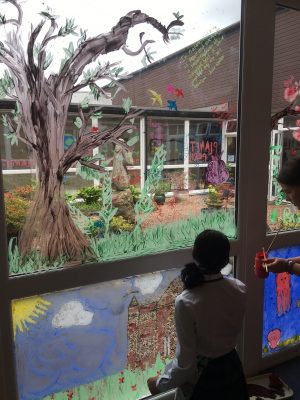
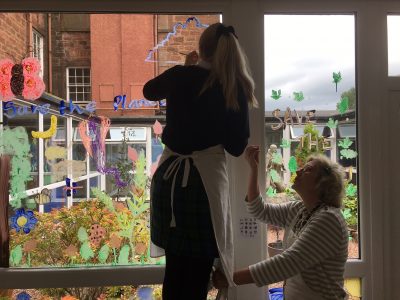
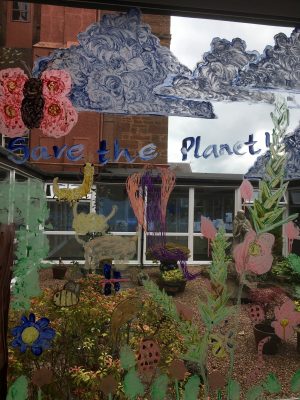
Kilgraston’s Glass Square is right at the centre of the School, a corridor ’roundabout’ directing pupils and staff in several directions. What better place then to host a vast mural, depicting personal interpretations of images from nature, designed to highlight the inter-dependency of the planet’s lifeforms?
English teacher, Mrs Saunders, had the idea, asking every pupil and staff member to add their bit for the impressive installation, hoping to create something that would make David Attenborough proud, urging: “Let us fill the space by painting paradise with a biodiversity bonanza.”.
Covid restrictions limited numbers which could congregate at one time, however, a strict booking scheme ensured Junior, Senior, Sixth Form and all boarders had their chance with a brush: “It’s very therapeutic,” commented U6s Anna, “it makes you stop and think and really visualise how everything in the natural world is connected.”
The mural will be continually updated and, hopefully, available for visitors to see and enjoy in the not-too-distant future.
I Talk To The Trees: Distance Learning Outside
As we face the prospect of watching one of Scotland’s famous long, hot summers pass by while at a safe social distance of at least two metres from each other, we have started to witness some unforeseen, though not entirely unwelcome, effects of our communal lockdown on the natural world. The European Space Agency reports decreased nitrous oxide levels of up to 80% over northern Italy. The waters of Venice lagoon are now so clear that fish are once again visible (though, sadly, the dolphin pictures appear to be fake). Deer are wandering through empty streets and subway stations in Nara, Japan, and boar have been strolling with impunity through the city of Barcelona.
So when the indoor classroom becomes too much, how else can you educate and entertain the troops. Here are some handy hints on using the nature we have on our own doorsteps:
- Birdwatching – get into your garden, or from a window in bad weather, and get birdwatching. Join in the fun via the Royal Society for the Protection of Birds social media channels and use #breakfastbirdwatch on to part of a virtual community of birdwatchers. The Society’s website also has a list of family-friendly activities, some of which – like building a bird box, planting flowers to attract bees and butterflies, and making a minipond – can be done in your own garden, as part of their ‘Wild Challenge’ award scheme.
- Live footage of animals - even on those occasional rainy days, there is no excuse for not connecting with nature. The Scottish Wildlife Trust maintains a series of webcams through which you can watch live footage from some of their reserves, including the famous osprey nest at Loch Leven; and Edinburgh Zoo has webcams in a number of their enclosures, including that of the pandas. If that’s not enough, the BBC have made nine separate Sir David Attenborough box sets available through the iPlayer, going all the way back to the classic 1979 series Life on Earth.
- Check out the Royal Horticultural Society’s ‘Grown Your Own’ advice page. Amidst the global spread of the coronavirus, it has reported a recent spike in traffic to this particular advice page, as people turn to gardening as a way to guard against food shortages as a result of panic buying, and as a way to maintain their mental health.
And remember, even if you’re not of the green-fingered persuasion, you could always tune up your guitar and head outside to greet nature with three chords and the truth, like the group of musicians in Sheffield who have been playing gigs in their back gardens to maintain community spirits while people are self-isolating. And remember the Norwegian saying, ‘Det finnes ikke dårlig vær, bare dårlige klær’ - There’s no such thing as bad weather, only bad clothing.
Dr Phillips, Head of Geography
Links
RHS ‘Grow Your Own’ advice page: https://www.rhs.org.uk/advice/grow-your-own
RSPB ‘Wild Challenge’ activities: https://www.rspb.org.uk/fun-and-learning/for-families/family-wild-challenge/activities/
Scottish Wildlife Trust webcams: https://scottishwildlifetrust.org.uk/things-to-do/watch-wildlife-online/
Happy DIY Home: https://happydiyhome.com/how-to-grow-your-own-food/
Edinburgh Zoo webcams: https://www.edinburghzoo.org.uk/webcams/
Sir David Attenborough box sets: https://www.bbc.co.uk/iplayer/group/p06m42d9
Naturewatch: The Cromwell Tree
On 30th January 1649, King Charles I was executed on a scaffold erected in front of the Banqueting House of the Palace of Whitehall in Westminster, London. In response, on 5th February, the Parliament of Scotland declared his son, Charles II, who was living in exile in the Netherlands, to be King of Scots.
Charles returned to Scotland on 23rd June 1650, landing at Garmouth, Moray and signing the 1638 National Covenant and 1643 Solemn League and Covenant which brought both Scottish Royalists and Scots Covenanters rallying to his cause. Less than a month later, on 22nd July, Oliver Cromwell and his New Model Army arrived in Scotland from Ireland and, by the end of the year, they had taken control of the city of Edinburgh and much of southern Scotland.
In a largely symbolic gesture, Charles was crowned at Scone on 1st January 1651; by July, Cromwell’s army had crossed into Fife and begun to advance towards Perth, stopping to rest at Bridge of Earn where, it being a Sunday, it is said that Cromwell preached an eloquent sermon. The Royalist garrison at Perth surrendered on 3rd August and, to maintain control of the city and its surrounding countryside, Cromwell ordered a citadel to be built on land that is now occupied by South Inch car park.
Of greater significance here, though, is a Spanish chestnut (or sweet chestnut) tree that was planted on the Kilgraston estate on the day of Perth’s surrender. If the story of its planting is true, this tree would now be approaching 369 years of age. However, while the upper part of tree appears to be a mass of dead branches, the lower part does show signs of fresh growth. The tree is still visible across fields to the north of school, a still-living reminder of Britain’s turbulent political and religious history.
Naturewatch: Snowdrops
Galanthus Nivalis
February blew in over-night: a
biting wind wrapped in overcast robes.
Heralding its arrival with
their own quiet, white trumpeting,
the snowdrops defy the frost.
They shove their heads up
and out of the
sodden, bleached leaves that
the trees cried in October.
Phoenix flowers - born again to eternal life.
They will come again in glory
each winter-tide.
A milky army, their ranks swell
on the riverbank, their white helmets catch
the weak winter sunlight and simulate snow.
I can’t help but join their rally-
two months till spring.
by Anna G-H, Lower 6
We celebrated our beautiful crops of snowdrops on Sunday 23rd February by opening our doors to the public for the annual Snowdrop Festival, as part of Scotland’s Gardens Scheme. Click here to read more.